
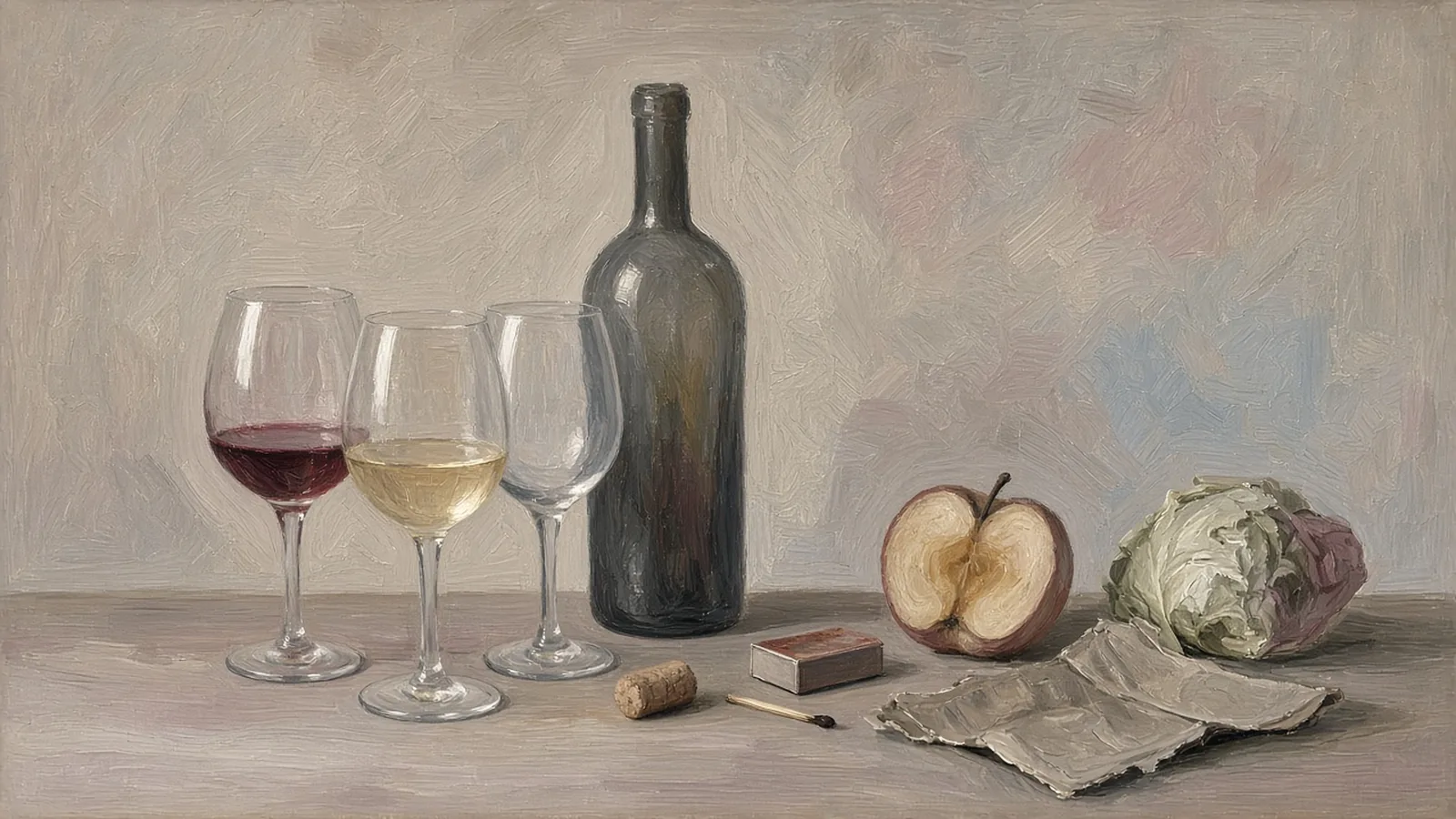
You might not like a wine and it can still be perfect. A fault is something else: an aroma or appearance that shouldn’t be there and that masks what the wine is. Before you judge, pour a little into a clean glass, at a good temperature, and smell it twice: as you pour and after swirling it for a minute.
The faults, one by one
Cork taint (TCA)
- What it smells like: wet cardboard, a damp cellar, old newspaper. In mild cases it doesn’t smell odd at all: the wine just seems dull, with no fruit.
- Why it happens: 2,4,6-trichloroanisole (TCA) forms when certain moulds transform chlorinated compounds, often in the cork, although it can also come from wood or the winery environment. It’s noticeable at minuscule concentrations, a few nanograms per litre.
- Can it be fixed? No. Aerating doesn’t remove it; given time in the glass it usually gets worse. It’s the clearest reason to send a bottle back.
Reduction (hydrogen sulphide and mercaptans)
- What it smells like: rotten eggs, a spent match, boiled cabbage, burnt rubber, garlic.
- Why it happens: sulphur compounds produced by yeasts during fermentation, especially if they lack nutrients, which the wine retains when it has had very little contact with oxygen (very airtight closures, ageing in tank).
- Can it be fixed? Often, if it’s mild: swirl the glass well, decant it and wait 15–30 minutes. Hydrogen sulphide goes with air; the more stubborn mercaptans and disulphides are harder and sometimes don’t go away.
Too much sulphur dioxide (SO₂)
- What it smells like: a freshly struck match; it prickles your nose.
- Why it happens: sulphur dioxide is used in almost all wines as an antioxidant and antiseptic. If you can smell it, there’s too much free SO₂, which is more common in young whites and recently bottled wines.
- Can it be fixed? Yes: aerate and wait. It dissipates in minutes or hours.
Volatile acidity
- What it smells like: vinegar; if ethyl acetate comes with it, also nail-polish remover or glue.
- Why it happens: acetic bacteria (and some yeasts) turn the alcohol into acetic acid when the wine is exposed to air, through badly topped-up barrels or poor hygiene.
- Can it be fixed? No. A little volatility adds lift and is accepted in some classic styles; when it dominates the nose, the wine is spoilt.
Brettanomyces (“Brett”)
- What it smells like: stable, horse sweat, dirty leather, sticking plaster, sometimes smoke or clove.
- Why it happens: a yeast that lives in barrels and wineries and produces volatile phenols (4-ethylphenol, 4-ethylguaiacol), especially in high-pH reds with little SO₂.
- Can it be fixed? No. At low levels some see it as “complexity”, but as soon as it wipes out the fruit it’s a fault.
Oxidation
- What it smells like: bruised or overripe apple, walnut, sherry where there shouldn’t be any. To the eye, whites turn golden or brown and reds go brick-coloured or brown.
- Why it happens: too much oxygen: a cork that has let air in, a bottle that’s too old or a bottle opened days ago.
- Can it be fixed? No.
Heat damage (“cooked” wine)
- What it smells like: stewed fruit, jam, compote; on the palate, flat and lacking freshness. Clues: the cork is pushed up or the wine has seeped through the foil.
- Why it happens: the bottle has been exposed to heat (a car boot in summer, a shop window in the sun).
- Can it be fixed? No.
Refermentation in the bottle
- What you notice: bubbles or a prickle in a wine that should be still, sometimes cloudiness and yeasty aromas.
- Why it happens: yeasts or bacteria start working again in the bottle on leftover sugar or malic acid.
- Can it be fixed? No. Careful: some young whites have a slight, intentional prickle (CO₂ from fermentation), and that isn’t a fault.
What can be fixed and what can’t
- Can be saved: mild reduction and excess SO₂. Swirl the glass, decant, wait. Read when and how to decant.
- Can’t be fixed: cork taint, high volatile acidity, marked Brett, oxidation, heat damage and refermentation. Neither air nor time gets rid of them.
It looks like a fault, but it isn’t
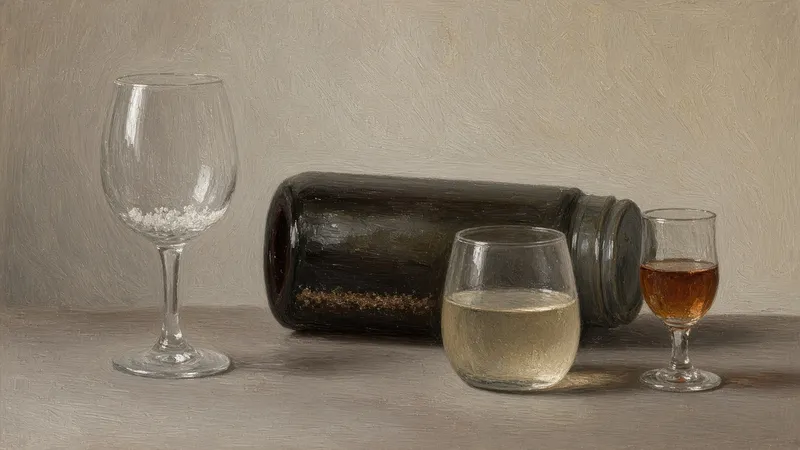
- Tartrate crystals. Small white crystals (or reddish ones, in reds) at the bottom of the bottle or stuck to the cork. They’re natural salts of tartaric acid that precipitate in the cold. They’re harmless: leave the last sip in the bottle.
- Sediment. Reds with years in bottle form sediment from tannins and pigments. It happens with long-lived classics such as Viña Tondonia Reserva or Gran Reserva 904. Just stand the bottle upright and decant.
- Cloudiness in unfiltered wines. Some producers bottle without fining or filtering so as not to strip anything from the wine; that’s the case with Pétalos. A slight haze is normal; what would be odd is a bad smell.
- Oxidative notes in wines that seek them. In an oloroso, an amontillado, a rancio wine or a Madeira, aromas of walnut, hazelnut or caramel are the style, not a fault: these wines are deliberately aged in contact with oxygen. The same happens, more subtly, with very long-aged Riojas.
At the restaurant: when to send a bottle back
When the sommelier lets you taste, they’re not asking whether you like the wine, but whether it’s sound. It’s reasonable to send it back if you notice cork taint, vinegar, oxidation, marked Brett or a cooked wine: tell them calmly and ask them to taste it; a good restaurant will change it. It isn’t a reason to send it back if you simply don’t like the style, or for mild reduction that goes away with air: in that case, ask for a decanter and give it a few minutes. Pay attention to temperature too: a red that’s too warm or an ice-cold white seem worse than they are (here’s the right serving temperature).
How to store wine to avoid faults
- Cool, stable temperature, ideally between 10 and 15 °C. More than the exact number, what matters is avoiding sudden changes and heat.
- Away from light, especially whites and sparkling wines in clear bottles.
- Bottles with corks lying down, so the cork doesn’t dry out. Screwcaps can stand upright.
- No strong smells or vibrations nearby (cleaning products, motors).
- Once opened, close the bottle and keep it in the fridge: most reds and whites keep well for 2–3 days.
Sources: Australian Wine Research Institute (AWRI), wine fault fact sheets; J. Robinson and J. Harding (eds.), «The Oxford Companion to Wine»; P. Ribéreau-Gayon et al., «Handbook of Enology».


