How to choose
If I had to keep just one of all the accessories on this website, I’d keep a great glass. You can have the best bottle in your cellar at the perfect temperature, but if you drink it from a thick tumbler or a tiny open-mouthed glass, much of what the winemaker has worked on for years gets lost along the way.
In my years in a winery’s sales department I saw tastings set up with first-class glassware and company lunches with banqueting glasses. The same wine seemed like a different one. It isn’t magic or snobbery: it’s physics. The shape of the glass decides how much air touches the wine, how the aromas are concentrated and where the liquid enters your mouth.
This guide isn’t meant to make you fill a cupboard with specialist glasses. It’s meant to help you understand what matters, so you buy a few very good ones and enjoy them for years.
What really matters in a glass
1. Fine, clear crystal
First, you need to be able to see the wine. Forget coloured glasses, cut or engraved bowls: colour and clarity tell you a great deal. Look for completely clear crystal and, if possible, a fine rim. A thick rim makes the wine “trip” as it enters your mouth and the sensation is coarser. Hand-blown glasses take this to the extreme, with almost imperceptible rims; but today there are also machine-made glasses with very fine rims, and that’s where the Good level starts.
2. A tulip-shaped bowl
The bowl should be wider at the base than at the mouth. That tulip shape lets you swirl the wine without spilling it and, above all, concentrates the aromas at the top so they reach your nose. Open-mouthed glasses shaped like an inverted cone (the typical ones in many bars) scatter the aroma: pretty, but not much use.
3. Enough size
A red wine glass should hold at least 450-500 ml, even if you only pour 120-150 ml. The empty space is what lets the wine breathe when you swirl it. For white, between 350 and 450 ml is a good range.
The stem isn’t decorative: it lets you hold the glass without warming the wine with your hand or leaving fingerprints on the bowl. The foot needs to be wide enough that the glass doesn’t tip over easily, which you’ll appreciate on a table full of plates.
5. Material: lead-free crystal or Tritan
Today most good everyday glasses are lead-free crystal. Some makers, such as Schott Zwiesel, use Tritan crystal, which contains titanium and zirconium for extra resistance to knocks and the dishwasher. At home, where glasses go in the machine and the odd one gets dropped, that’s a huge advantage.
Do I need a different glass for each wine?
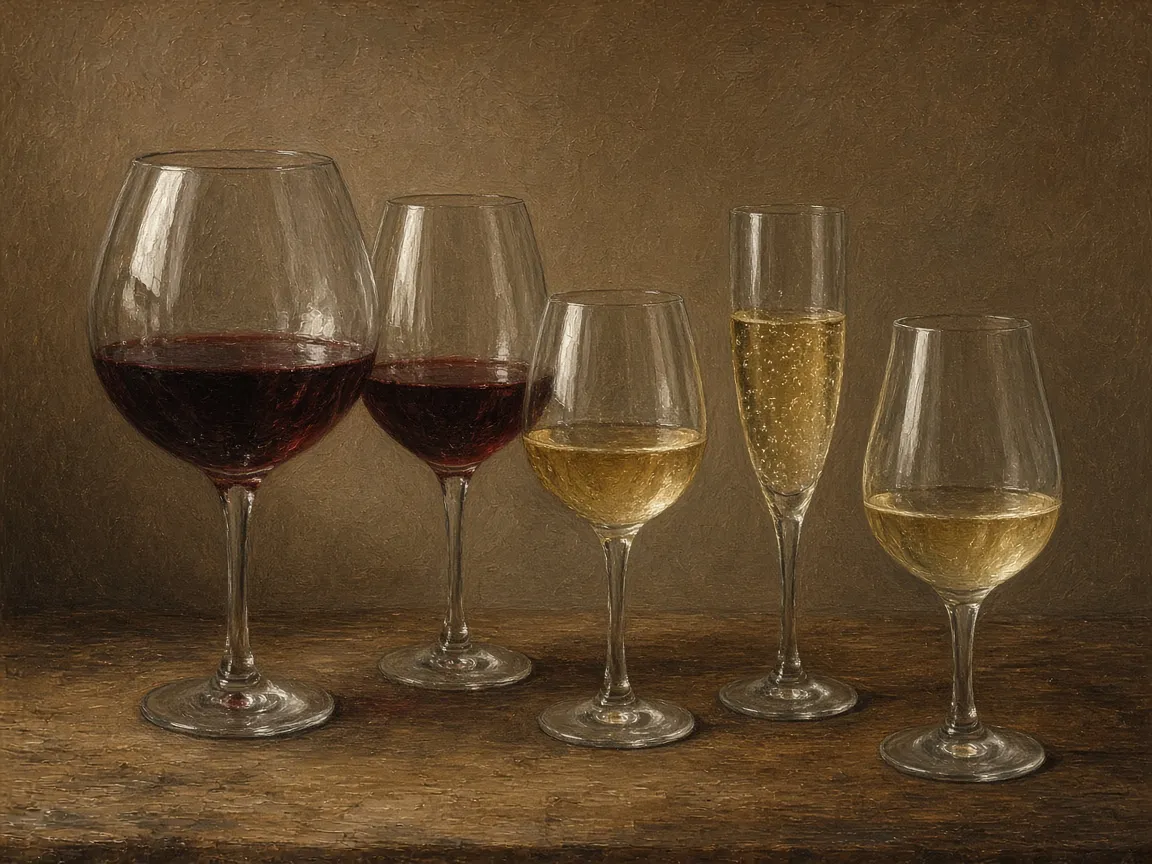
The honest answer is: no. The big brands have popularised collections with a glass for each variety (Cabernet, Pinot Noir, Syrah, Riesling, Chardonnay…). In a restaurant with a long wine list or at a professional tasting they make sense. At home, most people drink better with two or three well-chosen models:
| If you mostly drink… | What I’d buy |
|---|
| Reds (Ribera, Rioja, Toro…) | A large Bordeaux-style glass, 550-700 ml |
| Reds and whites equally | A Bordeaux glass for reds and a 350-450 ml white wine glass |
| A bit of everything, with limited space | A “universal” glass of about 450-500 ml |
| Lots of cava or Champagne | Add a tulip-shaped sparkling wine glass |
Red wine glass
For the structured reds so common in Spain —a Ribera del Duero, a Rioja reserva, a Toro— the Bordeaux-style glass is the safe bet: tall, with a wide bowl and a slightly narrower mouth. It leaves room for the wine to open up and directs it to the centre of your tongue, softening the feel of the tannin.
The Burgundy-style glass, with a very wide balloon, is designed for more aromatic and delicate wines, such as a Pinot Noir or a fine Mencía. It’s beautiful, but it takes up a lot of room, breaks more easily and isn’t essential. If you love those wines, go for it; if not, start with the Bordeaux.
White wine glass
A young, aromatic white (an Albariño, a Verdejo, a Sauvignon Blanc) shines in a smaller glass than a red one, with a slightly closed mouth. The smaller size helps keep the wine cool for longer, because you pour less and it warms up less.
Barrel-aged or very full whites (a Godello on lees, a barrel-fermented Chardonnay) appreciate a wider glass. In practice, many enthusiasts end up using the red wine glass for these whites, and it works very well.
Sparkling wine glass
Here I’ll speak out against the narrow flute. It’s elegant and keeps the bubbles, but it barely lets you appreciate the aromas. More and more cava and Champagne producers recommend a slightly wider, tulip-shaped sparkling wine glass, or even a white wine glass. A long-aged cava or a Champagne with years on its lees has plenty of aromas that the flute hides.
And the coupe, the wide, flat glass from old films? Very photogenic, but the bubbles vanish in minutes and the aromas escape. For cocktails, yes; for a good sparkling wine, better not.
Hand-blown or machine-made crystal
Hand-blown crystal is finer and lighter and, in a good glass, you notice it on the palate: the wine goes in without a “step”, the glass almost disappears in your hand and the aromas come across more clearly. It’s also more expensive and needs a bit more care. High-end machine-made glasses, such as Schott Zwiesel’s, have come very close and are perfect for everyday use.
My advice: have a top-quality set of six for every day and, for the special bottles, a few hand-blown glasses. That’s what many of us in the trade do at home.
The brands I like
- Schott Zwiesel (Zwiesel Glas). German Tritan crystal, tough and fine. The set of six Pure Bordeaux glasses is my Good level: highly rated and around 50 €.
- Krosno. Polish glassmaking with almost a century of craft. Its Avant-Garde line is an excellent buy for every day, and the hand-formed Symphony collection offers the finesse of a blown glass at a very reasonable price.
- Josephine (Josephinenhütte). The collection designed by Kurt Josef Zalto, mouth-blown, with a “waist” in the bowl that concentrates the aroma. N° 2 is a tasting-grade universal glass and N° 3 the one for great reds.
- Zalto. The Denk’Art Bordeaux is the reference glass for many sommeliers: ultralight and angular. Delicate, but unforgettable.
- Riedel. The house that popularised the variety-specific glass. Veloce is fine and light; Superleggero, one of its top ranges.
- Gabriel-Glas. A single universal glass, in StandArt (machine-made) or Gold (mouth-blown) versions. Ideal if you want just one model.
How many glasses to buy?
Think about how you’ll really use them:
- A couple or a single person who drinks wine a day or two a week: 4 red and 4 white glasses are usually enough.
- If you often have guests: sets of 6, and consider having 6-8 glasses of a universal model for when the table grows.
- Always allow for breakages: buy one or two extra. Glasses break, and finding the same model years later isn’t always easy.
Care and cleaning
A dirty glass, or one that smells of the cupboard, ruins any wine. A few tips I learnt from sommeliers:
- Dishwasher, yes, but sensibly. If the maker says they’re dishwasher-safe, use it, but make sure they’re held firmly without touching each other, and avoid very hot programmes and too much rinse aid.
- By hand, very little soap. Hot water and a drop of neutral soap. Rinse very well: detergent residue alters the aroma and kills the bubbles in sparkling wine.
- Dry with a microfibre or linen cloth, holding the glass by the bowl, never twisting the foot against the bowl: that’s the classic way to snap a glass.
- Store them upright if the cupboard is wooden or smells musty; upside down they trap odours. Before pouring, smell the empty glass. If it smells of anything, rinse it with a little of the wine itself (“seasoning” the glass).
Common mistakes when buying glasses
- Buying glasses that are too small. It’s the most common mistake. A 250 ml glass is little more than a tumbler with a stem.
- Getting carried away by design. Stemless glasses, coloured ones or impossible shapes: they look good in photos, but they don’t help the wine.
- Buying an entire collection at once. Better to start with a good red wine model and a white one, and expand later.
- Paying for the brand and not the glass. An expensive glass with a small bowl or a thick rim is still a bad glass. Look at the shape, size and rim.
- Forgetting about height. A large Bordeaux glass can be over 25 cm tall. Measure your cupboard before you buy.