Lever corkscrew on a wooden table

Accessories

Corkscrews and openers

Nine types of opener explained with their pros and cons, and my three go-to corkscrews: from the professional standard to the artisan piece.

Photo: Daniel F / Unsplash

Quick pick · Good · Better · Pro

Corkscrews

Good Proven quality

The professional waiter's standard

Original painting of Pulltap's Genuine Classic 500
Pulltap's

Pulltap's Genuine Classic 500

  • Double lever: a straight, effortless pull
  • Non-stick 5-turn worm, well centred
  • Made in Spain, lasts for years of service

approx. 10-20 €Approximate price; check the current price on Amazon.

Pros and cons

Pros

  • Double lever: a straight, effortless pull
  • Non-stick 5-turn worm, well centred
  • Made in Spain, lasts for years of service

Cons

  • Takes a little practice at first
  • The hinged blade isn't as good as a sliding one
Better My recommendation

A lever for effortless opening

Original painting of Le Creuset LM-250 sacacorchos de palanca + cortacápsulas
Le Creuset (Screwpull)

Le Creuset LM-250 lever corkscrew + foil cutter

  • Two movements and the cork comes out straight
  • Metal construction and replaceable worm
  • Comes in a case, very giftable

approx. 100-140 €Approximate price; check the current price on Amazon.

Pros and cons

Pros

  • Two movements and the cork comes out straight
  • Metal construction and replaceable worm
  • Comes in a case, very giftable

Cons

  • Bulky: won't go in your pocket
  • With very old corks, better a two-prong opener or a Durand
Pro The very best

A French artisan piece

Original painting of Laguiole en Aubrac Sommelier
Laguiole en Aubrac

Laguiole en Aubrac Sommelier (waiter's corkscrew)

  • French craftsmanship, with a certificate of authenticity
  • Fine finishes: olive wood, horn, exotic woods
  • Double step and a long five-turn worm

approx. €500-565 (Amazon.es, third-party sellers)Approximate price; check the current price on Amazon.

Pros and cons

Pros

  • French craftsmanship, with a certificate of authenticity
  • Fine finishes: olive wood, horn, exotic woods
  • Double step and a long five-turn worm

Cons

  • Priced like a designer piece
  • Beware of imitations: buy only from the maker or official distributors
Photo: oussama laabidate / Unsplash
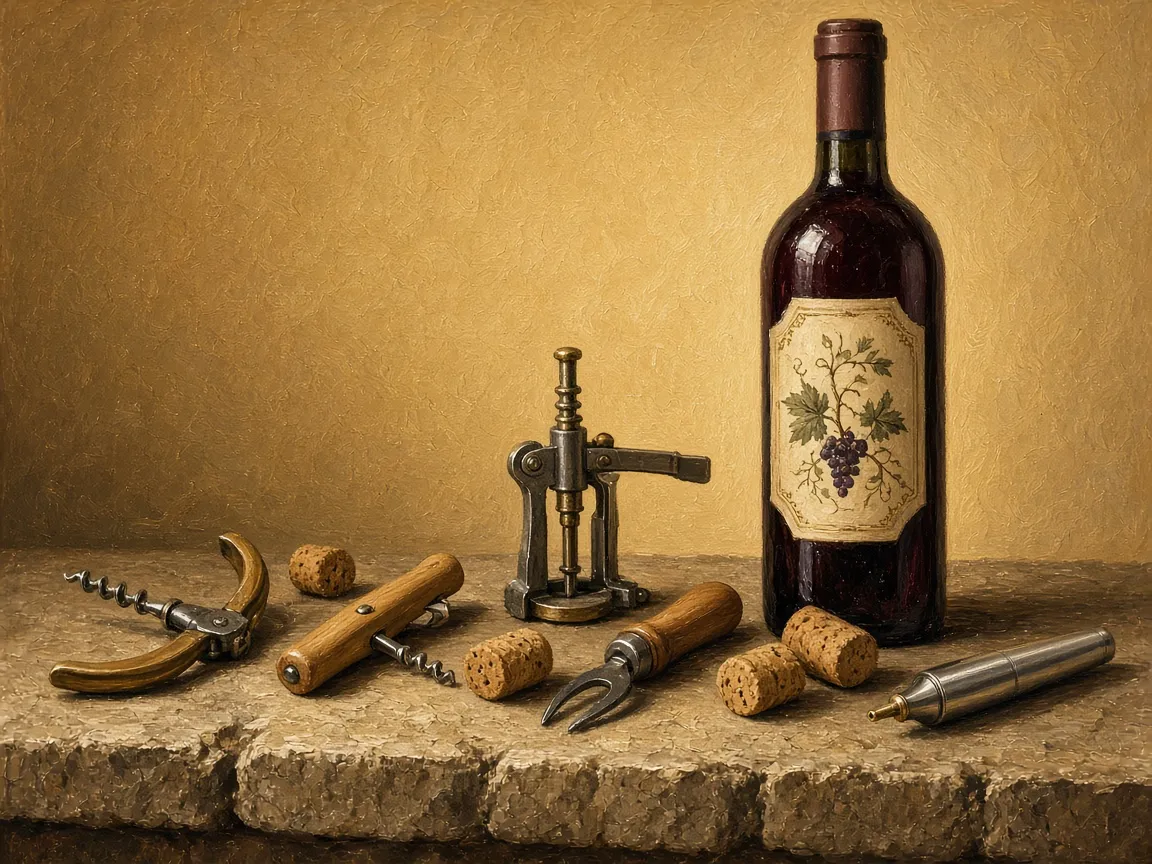
Still life with wing, lever and waiter's corkscrews, a two-prong opener and an argon device
Wing, lever and waiter's corkscrews, a two-prong opener and an argon system · Original painting · inspired by Juan Sánchez Cotán
Photo: Jean-Luc Benazet / Unsplash

How to choose

There are few things more awkward than a cork snapped in half in front of your guests, especially when the bottle is a special one. And it’s almost never the cork’s fault, it’s the corkscrew’s. In my years in the trade I’ve seen sommeliers open a thirty-year-old gran reserva without a crumb in the wine, and hosts with an enviable cellar wrestling with a freebie promotional opener.

Above you’ll find the comparison of the nine types of corkscrew out there and my three recommendations by level. Here I explain what makes a corkscrew good, how to use it like a professional and which combination I’d have at home.

What makes a corkscrew good

Whatever the type: if it fails on these points, it isn’t worth it, whatever it costs.

The worm (or spiral)

It’s the most important part. A good worm should be:

  • Hollow in the middle, like a spring, not a solid screw. A hollow worm grips the cork without tearing it; a solid screw acts like a drill and shreds it.
  • Long, about five turns, to reach the bottom of the long corks in wines for ageing (in great Bordeaux and Riojas they often exceed 50 mm).
  • Non-stick coated or finely polished, so it goes in smoothly.
  • With the tip centred on the worm’s axis, so it goes in straight.

The fulcrum

The lever is what saves you effort. The straighter the extraction, the less chance the cork has of breaking, especially with old, dry corks. That’s why the double step is now standard on quality waiter’s corkscrews.

The blade and materials

A micro-serrated blade cuts the foil cleanly below the lip of the bottle, so the wine doesn’t touch the metal as you pour. In artisan pieces, the steel, the fit of the parts and the handle matter too: olive wood, horn or fine woods that age well with use.

How to use a waiter’s corkscrew like a sommelier

  1. Cut the foil below the lip, turning the bottle rather than your wrist.
  2. Place the tip of the worm slightly off-centre and straighten the worm as you start turning, so it goes in through the centre of the cork.
  3. Turn until one turn of the worm is left showing. Don’t bury it completely: going right through the cork drops crumbs into the wine.
  4. Rest the first step on the rim and lift the handle halfway.
  5. Switch to the second step and finish pulling the cork out with a smooth, straight movement.
  6. Finish the last few millimetres by hand, twisting the cork slightly: it comes out silently, just like in a restaurant.

The story of the double step

The classic waiter’s corkscrew had just one fulcrum: you had to pull hard at the end and the cork came out at an angle. In the mid-nineties, an inventor from Sabadell, Ramón Brucart, patented the double-lever system: first you pull the cork halfway and then you finish straight with the second step. That invention gave rise to Pulltap’s, and today the great French artisans use it too.

Old corks: the right tool

If you have wines over twenty years old, a worm alone isn’t enough. The cork dries out, loses elasticity and crumbles. That’s where the two-prong opener (Ah-So type) comes in, hugging the cork without piercing it, and The Durand, which combines worm and prongs for the safest extraction I know. If you keep collector’s bottles, having one of the two is almost a must.

What if the cork breaks?

It happens to the best of us:

  1. If a piece is left inside, drive the worm in again at an angle, resting it against the glass, and pull very carefully. If you have a two-prong opener, now’s the time to use it.
  2. If the piece crumbles, push it in and decant the wine through a fine strainer. The wine won’t spoil from a few minutes in contact with the cork.
  3. If it happens to you often, check the worm: it’s probably worn or solid.

Common mistakes

  • Not cutting the foil, or cutting it above the lip: the wine brushes the metal as you pour.
  • Driving the worm in crooked, which leaves a very thin wall of cork on one side.
  • Going right through the cork, which drops crumbs into the wine.
  • Using a worm on a 30-year-old cork: that’s a job for the two-prong opener or the Durand.
  • Opening a sparkling wine with a worm: never. Take off the cage, hold the cork and turn the bottle.

Comparison

Types of corkscrew

Nine ways to open a bottle, from the sommelier knife to the needle system. For each one: how it works, who it makes sense for, and its pros and cons.

TypeIdeal forEffortOld corksPortableApprox. price
Double-lever waiter's friendAlmost everything: from a Tuesday-night wine to a bottle you've cellaredLow, with techniqueGood (with a long worm and care)Yesapprox. 10-350 €
Lever (Rabbit-style)Long meals at home, tastings, anyone who opens lots of bottlesMinimalCareful: the fast pull can break themNoapprox. 100-140 €
ElectricMobility problems or arthritis; anyone who opens a bottle every dayNoneNot recommendedSo-soapprox. 25-40 €
Two-prong (Ah-So)Old wines with crumbling corksMedium, with techniqueExcellentYesapprox. 15-30 €
The DurandCollectors of 20, 30 or 40-year-old winesMediumThe bestYesapprox. 140-180 €
Wing (butterfly)Occasional use, anyone looking for something intuitive and stylishLowSo-soNoapprox. 35-60 € (design)
Continuous-turn Screwpull and table-mountedHome cellars, private bars, eventsMinimalSo-soNovaries; bar-mounted ones are investment pieces
Needle with argon (Coravin)Great wines you want to enjoy glass by glass over monthsNoneCarefully: very old corks may not resealSo-soapprox. 250-650 €
For sparkling wines: pliers and Champagne openersOnly for cava, Champagne and sparkling wines with mushroom corksLowNot applicableYesapprox. 15-60 €
01

Double-lever waiter's friend

Waiter's friend, sommelier knife

A folding pocket opener with a blade, a worm and a stepped lever that rests on the bottle's lip. First you use the first step and pull the cork halfway; then the second, and finish pulling it out straight. It's what sommeliers and waiters carry.

Pros
  • Versatile, light and professional
  • No batteries or parts to fail
  • The artisan versions last a lifetime
Cons
  • A small learning curve
  • With many bottles in a row, your wrist gets a little tired

Quality examples: Pulltap's Genuine (the original from Sabadell), Laguiole en Aubrac, Château Laguiole Grand Cru.Product cards:Pulltap's Genuine Classic 500, Laguiole en Aubrac Sommelier (waiter's corkscrew), Château Laguiole Grand Cru.

02

Lever (Rabbit-style)

Lever, Leverpull

It grips the neck with two handles; you lower the lever to drive in the worm and raise it again to pull the cork. Two movements and the cork comes out straight, effortlessly.

Pros
  • Speed and a straight pull
  • Ideal for hands with little strength
  • Replaceable worm on the good models
Cons
  • Bulky
  • Not the best option with corks over 20 years old

Quality examples: Le Creuset LM-250 (heir to the original Screwpull).Product cards:Le Creuset LM-250 lever corkscrew + foil cutter.

03

Electric

Rechargeable

A motor turns the worm, which goes in and pulls out the cork at the push of a button. Good models are rechargeable and open dozens of bottles per charge.

Pros
  • Zero effort
  • Very convenient for daily opening
Cons
  • Depends on the battery
  • Little control with fragile corks or hard synthetic ones

Quality examples: Arcos (Albacete cutlery maker, with after-sales service).Product cards:Arcos rechargeable electric corkscrew.

04

Two-prong (Ah-So)

Two-prong, butler's friend

Two metal prongs of different lengths are rocked in between the cork and the glass. You twist and pull at the same time, and the cork comes out whole and unpierced.

Pros
  • Whole cork even if it's fragile
  • Lets you re-cork with the same cork
Cons
  • Less intuitive technique
  • If the cork is loose, it can push it in

Quality examples: Monopol (Westmark), made in Germany.Product cards:Westmark Monopol Ah-So two-prong opener.

05

The Durand

Worm + prongs

A two-piece hybrid: first you drive a thin worm into the centre of the cork; then you slide the prongs down the sides and turn both at once. The worm holds and the prongs hug.

Pros
  • The safest extraction for very old corks
  • Solid and well built
Cons
  • Expensive for daily use
  • Two steps and some practice

Quality examples: The Durand.Product cards:The Durand (worm + prongs for old corks).

06

Wing (butterfly)

Wing corkscrew

As you turn the worm, the two side arms rise; when you push them down, the pinion pulls the cork. The classic in many kitchens.

Pros
  • Very intuitive
  • The design versions decorate your kitchen
Cons
  • The worms on cheap models shred the cork
  • The pull isn't always straight

Quality examples: Alessi Anna G, by Alessandro Mendini.Product cards:Alessi Anna G (wing corkscrew).

07

Continuous-turn Screwpull and table-mounted

Table-mounted, bar-mounted

The long non-stick worm turns inside a frame that rests on the neck: you keep turning the same way and the cork rises by itself. Table or bar versions are fixed to the worktop and open with a single lever, like in old-school bars.

Pros
  • Smooth, straight extraction
  • Bar-mounted ones open dozens of bottles without tiring you
Cons
  • Bar-mounted ones need installing
  • They take up space

Quality examples: Screwpull by Le Creuset; bar openers fixed to a worktop.

08

Needle with argon (Coravin)

Pour-without-uncorking system

A very fine needle goes through the cork, argon pushes the wine into the glass and protects the rest of the bottle. When you withdraw the needle, the natural cork closes up again. It's not a corkscrew: it's a way of pouring.

Pros
  • You pour without opening the bottle
  • Keeps the rest for months
Cons
  • High investment plus argon capsules
  • Natural cork only

Avoid cheap needles that inject air or CO₂ to push the cork out: they add nothing and can be dangerous with flawed bottles.

Quality examples: Coravin Timeless Three+ and Model Eleven.Product cards:Coravin Timeless Three+ (needle system), Coravin Model Eleven (automatic needle system).

09

For sparkling wines: pliers and Champagne openers

Champagne pliers, star

Cavas and Champagnes aren't opened with a worm: you remove the cage and turn the bottle while holding the cork. Pliers or a four-pointed star help with very tight corks or when serving many bottles.

Pros
  • They open the hardest corks effortlessly
  • Safer: the cork doesn't shoot out
Cons
  • A very specific tool
  • With practice, your hand is enough for most bottles

For very old vintage port there are port tongs, which cut the neck with heat. They're a sommelier's curiosity, not a necessary purchase.

Quality examples: Champagne pliers from quality cutlers.

Photo: Jametlene Reskp / Unsplash

More options

Alternatives I also recommend, on top of the three above.

Original painting of Westmark Monopol Ah-So abridor de láminas
Monopol (Westmark)

Westmark Monopol Ah-So two-prong opener

A German two-prong opener: slide the prongs between cork and glass, twist and pull. The cork comes out whole and unpierced.

Pros
  • Ideal for old corks that crumble
  • Lets you re-cork with the same cork
  • Made in Germany
Cons
  • Less intuitive technique than a worm
  • With corks stuck to the glass it can push them in

approx. 15-30 €Approximate price; check the current price on Amazon.

View on Amazon
Original painting of Arcos sacacorchos eléctrico recargable
Arcos

Arcos rechargeable electric corkscrew

An electric opener with rechargeable battery and foil cutter, from the Albacete cutlery maker. Zero effort for anyone who opens a bottle every day or has delicate hands, with well-known after-sales service.

Pros
  • Opens at the push of a button
  • Foil cutter included
  • Spanish brand with after-sales service
Cons
  • Depends on the battery
  • Less control with old or fragile corks

approx. 35-45 €Approximate price; check the current price on Amazon.

View on Amazon
Original painting of Coravin Timeless Three+
Coravin

Coravin Timeless Three+ (needle system)

The sommeliers' system: a needle goes through the cork, you pour your glass and argon protects the rest for months or years.

Pros
  • Pours without uncorking the bottle
  • Ideal for tasting great bottles glass by glass
  • Includes aerator and screwcap stoppers
Cons
  • High investment plus capsules
  • Needs a natural cork in good condition

€279.00 at DecántaloPrice seen at Decántalo on 02/11/2026; check the current price.

View at Decántalo
Original painting of WMF Clever & More sacacorchos de alas con abrebotellas
WMF

WMF Clever & More wing corkscrew with bottle opener

A 2-in-1 wing corkscrew with bottle opener: place it on the bottle, turn the handle and press the levers down. Coated worm that works with natural and synthetic corks.

Pros
  • Very easy, effortless to use
  • Opens crown caps too
  • Well rated on WMF's shop
Cons
  • Bulkier than a waiter's friend
  • Not dishwasher safe

€16.99 at WMF (was €22.99)Price seen at WMF on 02/11/2026; check the current price.

View at WMF
Original painting of WMF Baric juego de sumiller
WMF

WMF Baric sommelier set (5 pieces)

A five-piece sommelier set from WMF's Baric line. A complete gift for someone starting to take wine seriously.

Pros
  • All the basics in one case
  • Gift-ready presentation
  • Discounted from the RRP
Cons
  • If you already own a corkscrew, you pay for pieces you won't use
  • Takes more space than a single accessory

€104.99 at WMF (was €149.99)Price seen at WMF on 02/11/2026; check the current price.

View at WMF
Original painting of Sacacorchos profesional de aire a presión con cortacápsulas
Genérico

Professional air-pressure corkscrew with foil cutter

An air-pressure opener: push the needle through the cork, pump, and the cork comes out by itself, no twisting. Built-in foil cutter included.

Pros
  • Opens with no effort
  • Built-in foil cutter
  • A fun gift
Cons
  • Not suitable for old or fragile corks
  • Generic brand

11,99 € on Amazon.esApproximate price; check the current price on Amazon.

View on Amazon

Instagram

Follow me on Instagram @todoparamisvinos

New wines, offers and paintings, as soon as I post them.

Follow @todoparamisvinos