How to choose
One of the questions friends and acquaintances have asked me most over the years is this: “Should I buy a wine fridge?”. And my first answer is almost always another question: how many bottles do you have, and how long do you keep them?
Because a wine fridge is neither a collector’s whim nor an essential appliance. It’s a tool that solves a specific problem: stopping wine from being spoilt by heat, temperature swings and light. In many Spanish homes, with long summers and flats without a cellar, that problem is real. But the right wine fridge for someone with ten bottles has nothing to do with the one for someone with a hundred and fifty.
What a wine fridge is for (and what it isn’t)
Wine is sensitive to four enemies:
- High temperature. Above 20-22 ºC wine evolves faster than you’d like. Above 30 ºC it can “cook” and lose fruit.
- Sudden temperature changes. More damaging than a constant, slightly high temperature. The wine expands and contracts, and the cork suffers.
- Light, especially ultraviolet, which degrades wine, above all in clear bottles.
- Vibration and dryness, which affect how the wine evolves and the cork.
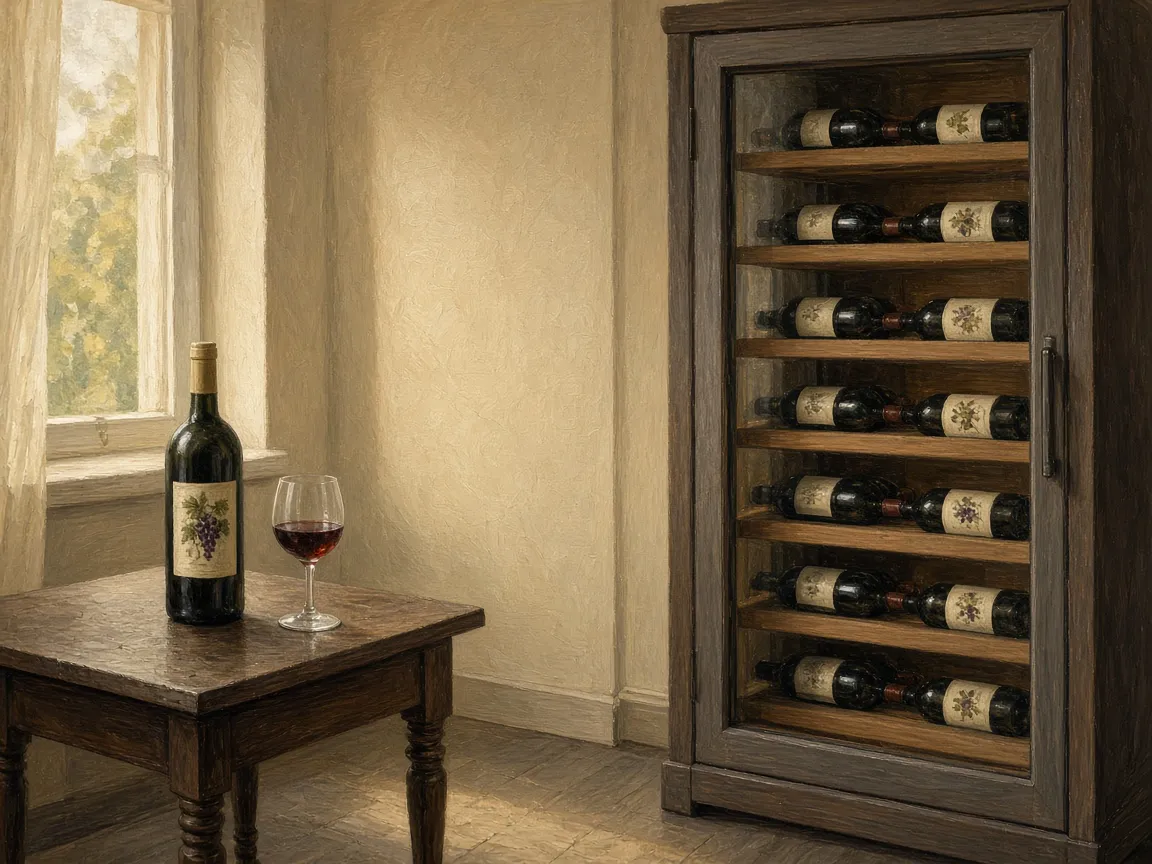
A wine fridge keeps a stable temperature, protects from light and, in the good models, controls vibration and humidity.
What it doesn’t do: improve a wine that isn’t meant for ageing. Most wines sold in supermarkets are made to be drunk within a year or two. For them, a wine fridge is mainly useful for keeping them at serving temperature, which is no small thing.
Won’t the fridge do?
For a few days, yes. For months, no. A fridge is at about 4-5 ºC, too cold for reds; it’s very dry, has compressor vibrations and is opened constantly. A white can sit there for a week without any problem; a bottle for ageing, better not.
Thermoelectric or compressor
This is the first big decision.
Thermoelectric wine fridges
They cool using a Peltier plate, with no gas or motor. Advantages:
- Very quiet and vibration-free.
- Cheaper at small capacities.
Drawbacks:
- They only cool a few degrees below room temperature, usually 8 to 12 ºC less. In a kitchen at 32 ºC in August, they won’t get down to 12 ºC.
- They lose efficiency in hot or poorly ventilated spots.
- They’re usually small (up to 15-20 bottles).
They’re ideal for flats with a controlled temperature, living rooms, studies or bedrooms where noise matters.
Compressor wine fridges
They work like a fridge, with refrigerant gas and a motor. Advantages:
- They cool powerfully, however hot it is.
- They reach lower, more stable temperatures.
- They’re the option for medium and large capacities.
Drawbacks:
- A bit more noise and some vibration (good models keep it to a minimum).
- Higher initial price in small sizes.
If you live somewhere hot or you’re putting it in a kitchen, garage or storeroom, my advice is clear: compressor.
One or two temperature zones
- One zone: the whole wine fridge at the same temperature. Perfect for storing wine long term (12-14 ºC is the ideal storage temperature for all wines, white and red).
- Two zones: a colder section (whites, rosés, sparkling, 6-10 ºC) and a warmer one (reds, 14-18 ºC). Designed for having wine ready to serve.
A common mistake is thinking reds should be stored at 18 ºC and whites at 8 ºC. For storing, all at 12-14 ºC. For serving, each at its own temperature. If you want both, two zones.
Manufacturers quote capacity calculated with standard 75 cl Bordeaux bottles, neatly arranged. In practice:
- Burgundy bottles (wider, typical of many Pinot Noirs, Godellos or Mencías) and sparkling wine bottles take up more room.
- Some designer bottles, taller or heavier, won’t fit on the shelves.
As a general rule, take 20-25 % off the advertised capacity. If you have 25 bottles, don’t buy a “24-bottle” wine fridge: buy one for 34 or more. Collections always grow.
Quick guide by how many bottles you have
Up to 24 bottles: a two-zone serving wine fridge
For anyone who buys good wine for the coming weeks and wants to have whites, sparkling and reds at their serving temperature at the same time. Here I already recommend a compressor, even if your flat is cool: it’s what guarantees stability in summer.
My Good level is the CASO WineComfort 24: German, compressor-based, with two independent zones, triple UV-filter glass, wooden shelves and a lock. It isn’t just any countertop wine fridge: it’s the gateway to wine that’s properly looked after.
From 24 to 40 bottles: specialist two-zone
This is the demanding enthusiast’s leap. Here you start to notice the difference between a wine fridge and a refrigeration specialist’s cabinet: temperature stability, insulation, no vibration and decades of service life.
My Better level is the Liebherr WTes 1672 Vinidor: about 34 bottles, two zones adjustable from 5 to 20 ºC, stainless steel and UV-protective glass. Expensive for its capacity, yes, but it’s one you won’t replace for many years.
From 40 to 100 bottles: large or built-in wine fridge
Now we’re talking about a collection. Priorities:
- A well-insulated compressor with low vibration.
- A door with anti-UV glass and, if possible, a lock.
- Pull-out wooden shelves on runners, to reach the bottles at the back.
- If you’re building it into kitchen units, it should be a model specifically designed for integration, with front ventilation. A freestanding wine fridge that’s built in overheats.
More than 100 bottles
That’s my case: at home I have a 120-bottle cabinet, and believe me, it fills up sooner than you’d think. For this Pro level I recommend a specialist manufacturer such as Liebherr: its WKb 4212 holds up to 200 Bordeaux bottles at a very stable storage temperature and leaves plenty of room for a collection that keeps growing. Another top-end reference is EuroCave, the French brand that invented the wine cabinet. For even bigger collections, the sensible thing is to combine a storage cabinet with a two-zone serving wine fridge, or to set up a small cellar in a basement or storeroom.
Other details that make a difference
- Noise: check the decibels. Below 40 dB you’ll barely notice it in a living room; in a bedroom, a thermoelectric one is better.
- Energy efficiency: many wine fridges have modest labels (classes E, F or G). That’s normal for the category, but compare annual consumption in kWh.
- Location: away from ovens, radiators and direct sunlight. Leave the ventilation space the manufacturer specifies.
- Humidity: ideally between 60 and 75 %. Simple models don’t control it; if you’re storing long term, a small container of water at the bottom helps.
- Lighting: LED, and it should be possible to switch it off. Light that’s on all the time does wine no favours.
Common mistakes
- Buying only just enough capacity. In a year the wine fridge will be full.
- Thermoelectric in a hot kitchen. It won’t be up to the job in summer.
- Building in a freestanding model. It overheats and the compressor suffers.
- Storing reds at 18 ºC for years. For ageing, 12-14 ºC.
- Filling it with wines that aren’t meant for ageing. Drink what you’ve got; wine is there to be enjoyed.