
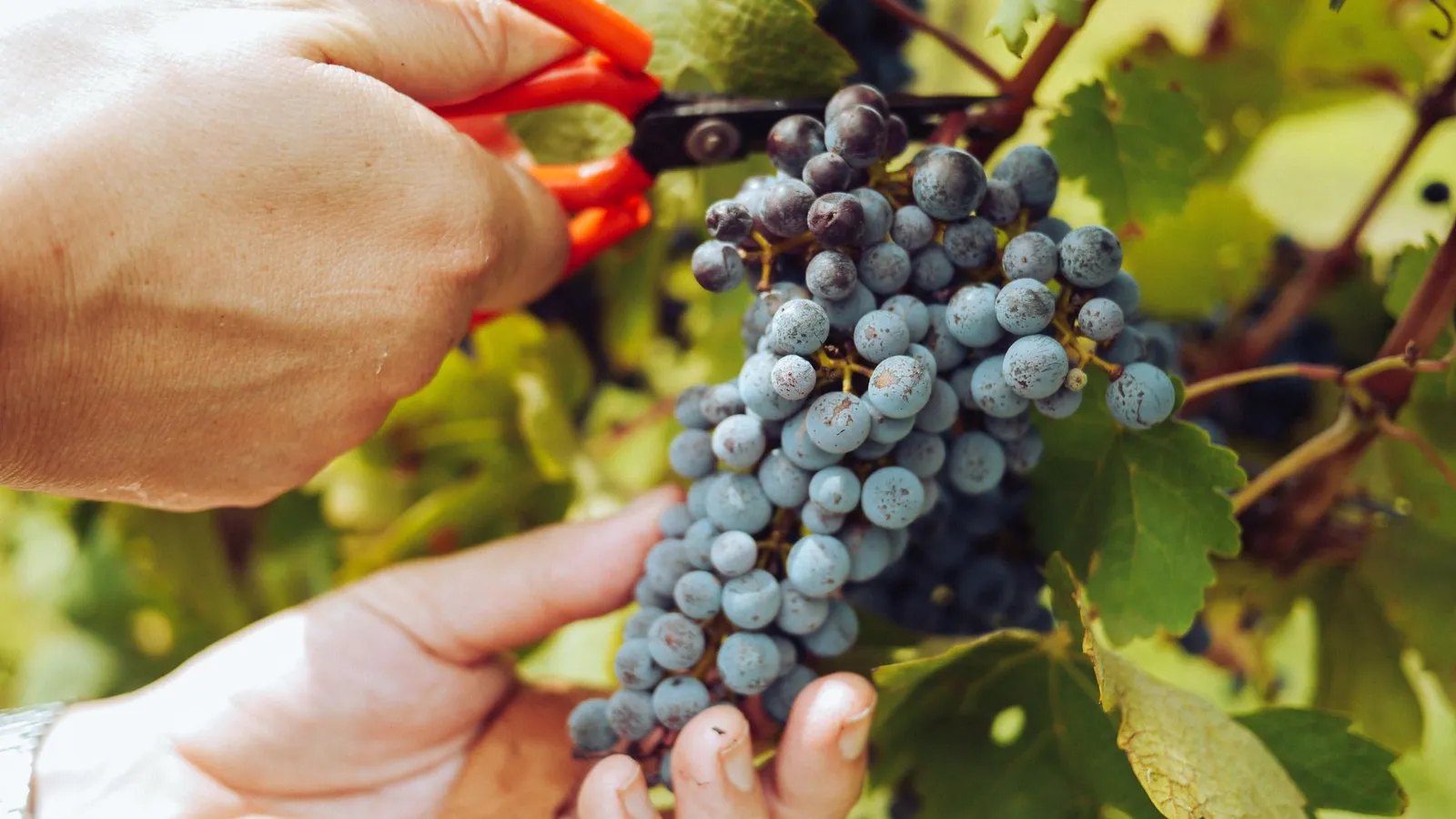
There’s one idea that has stayed with me ever since I started getting interested in how wine is made: almost everything a good winery does is about protecting what the grape already brings. Freshness, acidity, aroma. The rest is style.
1. The harvest
Picking the grapes at the right moment
Grapes don’t ripen after they’re picked, the way a tomato picked green finishes ripening in your kitchen. That’s why the harvest date is one of the most important decisions of the year: the grapes are picked when the balance between sugar, acidity and skin ripeness is exactly what’s wanted.
At night and in the cold
In warm regions, many wineries harvest at night: they start once it has cooled down and finish before sunrise. The grapes arrive cold at the winery, which helps preserve acidity, freshness and aromas. On arrival, they often go straight into cold rooms.
By hand, with sorting
For the most carefully made wines, the grapes are picked by hand into small crates and sorted again on a sorting table: unripe or damaged bunches and bits of leaf are removed. Machine harvesting is quicker and cheaper, but less selective.
2. In the winery: cold and no oxygen
The cold chain
In the most technical wineries, temperature can be controlled throughout almost the whole process: tanks refrigerated from top to bottom, presses, pipework and bottling. Controlling the temperature of the grapes, the must and the wine means controlling the result.
Oxygen, the great enemy
Wine always contains natural bacteria and yeasts, and many of the ones that spoil it need oxygen to act. That’s why many wineries protect the must and the wine from air at all times: they press under nitrogen, blanket the tanks with inert gases (such as nitrogen or argon) and move the wine by pressure instead of pumping it with air. That way the wine doesn’t oxidise and the risk of faults is reduced.
Stems, yes or no
Most wineries destem: they separate the grapes from the stems (the bunch’s “skeleton”), which can bring bitter, green flavours. Others ferment with some of the stems or with whole bunches, and some of them make extraordinary wines. It’s a question of style, and you can tell in a tasting.
3. The key: the grape skin
I like to explain it this way: deep down there are only two kinds of grape, white and black. And the juice of almost all of them is practically colourless. What changes is the skin: that’s where the colour is, much of the aroma and the tannins, which give structure on the palate. Depending on how long the must spends in contact with the skins, you get very different wines:
- White from white grapes. The grapes are pressed gently, without crushing seeds or skins, and only the clean must is fermented.
- White from black grapes. With very gentle pressing that extracts no colour, a black grape can also make white wine. In Champagne this is called blanc de noirs (from Pinot Noir and Meunier); if the Champagne is made only from Chardonnay, it’s a blanc de blancs.
- Rosé. The must spends a short time with the black grape skins: a few hours. The more contact, the more colour and tannin; very pale rosés, in the Provence style, are mainly after fruit and freshness. Colour is a consequence of the process, but it gives it away.
- Orange wine. White grapes fermented with their skins, as if it were a red: it gains colour, texture and tannin.
- Red. Black grapes fermented with their skins for days: hence the colour and structure.
4. Fermentation
Clearing the must
For whites and rosés, the freshly pressed must is left to settle in the cold for a day or two so the solid matter drops out (débourbage). Then the clean must is moved to another tank and the sediment discarded, which can be a sizeable part of the volume. It’s one of the reasons why a kilo of grapes gives nowhere near a bottle of quality wine.
Yeasts
Yeasts turn the grape’s sugar into alcohol. Some wineries use only the native yeasts that come in on the grapes and live in the winery; others add selected yeasts to control fermentation better or to run several different fermentations and add complexity. A fermentation usually lasts around one or two weeks.
Dry or sweet
A dry wine is one in which the yeasts have turned practically all the sugar into alcohol. A wine smelling of ripe fruit doesn’t make it sweet: sweetness is sugar. To make a sweet wine, sugar isn’t added; instead, fermentation is stopped before it finishes (common in Germany and Austria) or very concentrated grapes are used, so residual sugar remains.
Malolactic fermentation
After the alcoholic fermentation another one can take place, the malolactic, in which bacteria turn malic acid (the one in green apples) into softer lactic acid. In almost all reds it’s encouraged. In many fresh whites and rosés it’s avoided, by keeping the wine cold, to preserve acidity and liveliness.
Reds: the “cap”
In a red, the skins rise to the surface of the tank and form the cap, which is where the colour and tannins are. To extract them, the cap has to be brought into contact with the must: by pumping over (must is pumped from the bottom and sprayed over the cap) or by punching down (the cap is pushed down, by hand or by machine). Fermentation also generates heat, and the temperature has to be controlled so the centre of the tank doesn’t get too hot.
Some wineries also do a cold soak before fermentation: with the must kept cold, so fermentation doesn’t start, they extract colour and fruit from the skins with less tannin.
5. Ageing
Why barrels
An oak barrel does two things:
- It adds aromas: vanilla, cocoa, spice or toasty and smoky notes, depending on the oak and how the barrel is toasted.
- It lets the wine breathe: a tiny amount of oxygen gets in through the wood (micro-oxygenation), softening the tannins over time.
Size matters: the smaller the barrel, the more oak it gives. That’s why many producers look for large barrels (500 litres or more), so the oak accompanies the fruit without masking it. Age counts too: a new barrel marks the wine much more than a second- or third-use one.
The art of blending barrels
One of the things that surprised me most is that two identical barrels with the same wine give different results. Each cooperage, each oak and each toast brings something different: one barrel gives more fruit, another more structure, another more acidity. The winemaker tastes barrel by barrel and blends, just as varieties are blended. Every now and then a single barrel turns out so special that it’s bottled separately.
In the bottle
Bottling is also done protecting the wine from oxygen. And the closure isn’t a detail: a natural cork lets very little air through, and technical corks and screwcaps allow even more control over how the wine evolves.
6. In short: the types of wine
| Type | Grape | Skin contact |
|---|---|---|
| White | White (or black, pressed very gently) | Minimal |
| Rosé | Black | A few hours |
| Orange | White | During fermentation |
| Red | Black | During fermentation (days or weeks) |
| Sparkling | White or black | Depends on the style; the bubbles come from a second fermentation |
Next time you have a glass in front of you, think about all that: the night of the harvest, the cold, the grape skin and the barrels. It makes me enjoy it even more.


